
ABOUT JATZO
Security tools should make people informed, not overwhelmed.
The person a scam email targets is rarely a security expert. Jatzo gives them a clear answer and a next step.
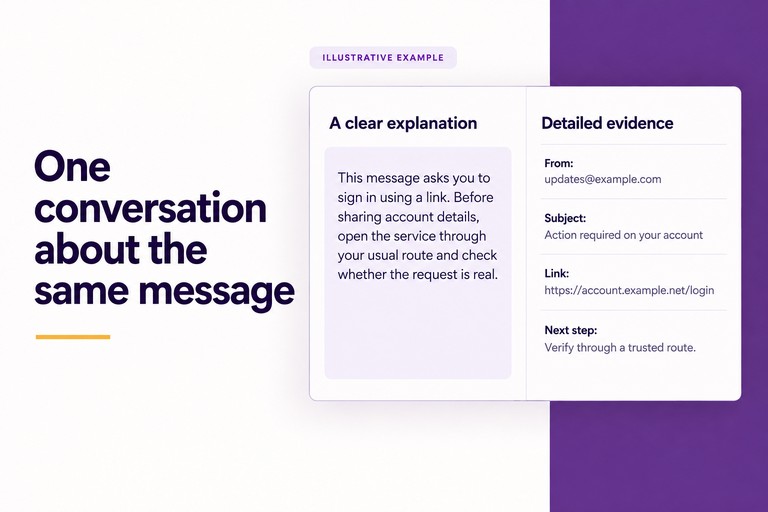
Most people are left to guess.
A suspicious message is one of the commonest moments when people have to make a security decision quickly, and the help around it rarely explains itself.
Filters decide in silence
Most junk never arrives, which is good. The message that does arrive comes with no explanation, and it is the one that matters.
Warnings without reasons
A banner that says be careful does not say careful of what, so people learn to click past it.
Lessons far from the inbox
Awareness training tends to happen once a year, and the email that needs it arrives on a busy Tuesday.
Check. Understand. Act.
One answer for the email in front of you, from the moment it feels wrong to the moment you know what to do.
Check. A second opinion, where you read it
In Outlook or on the website, with the same engine and the same answer on every plan.
Understand. The evidence, in plain English
What raised a concern and why it matters, with the technical detail there for whoever wants it.
Act. The next step, every time
What to do before you click, reply or pay, and a way to tell your IT team when you work in one.
Explainable before automated.
The engine uses stable detection signals, contextual scoring and conservative learning. It avoids treating one keyword, one blacklist or its own previous verdict as unquestionable truth.
Every point has a reason
A clear risk rating with reasons you can read and practical checks you can make.
Claims are not proof
Uploaded header claims are treated cautiously. A familiar name or reported authentication pass does not make a request safe.
Nothing is run
Attachments are profiled without execution, including file mismatch, archives, Office and PDF behaviours, embedded URLs and nested messages.
No raw messages kept for learning
Threat Memory and Campaign Intelligence use keyed fingerprints and scoped feedback rather than storing raw messages as community training data.

We do not keep the email you check.
Jatzo reads the message and its attachments to run the analysis, then releases them. The raw email, its contents and its attachments are not saved in your history. What is kept is the subject line, the score, the short list of findings and a few counts, such as how many links there were, so you can recognise a check later. In your history, links and senders are kept only as keyed fingerprints that cannot be read back, which is how Jatzo notices the same campaign returning. The detailed evidence behind a PDF report, such as the full links, is held in memory for up to 30 minutes and then deleted.
- No raw email or attachment content stored
- The message itself is never stored, so nobody is shown it. In a business team, the admin and moderators see each check's subject line, score and findings
- Attachments are opened only inside an isolated worker, never run
- No third-party advertising trackers
A practical tool for everyday decisions
Jatzo brings together sender and message checks, supported attachment inspection, QR codes read from pictures, PDFs and Office documents, connection warnings and plan-based network and reputation evidence. We explain what was checked, what was unavailable and what to verify next.
Our guides offer beginner and advanced explanations. Reports use the same Case ID as your history so an individual or their IT adviser can discuss the same evidence. Jatzo supports your judgement; it cannot guarantee that a message is safe.
Business workspaces provide individual logins, one allowance shared by the team, and admin and moderator access to retained business reports.
Jatzo is built by one person, on purpose.

I grew up with a family obsessed with computers, so there was usually one in pieces on a table somewhere and somebody arguing about why it would not turn on. I was given a laptop of my own when I was nine, and that was more or less that. The years after it went on taking things apart to see how they worked, putting most of them back together, and reading far too late into the night about whatever had broken that week.
I am a self taught developer. Everything I know about building software I picked up because I wanted to make something and had to work out how first, and none of it was taught to me formally. The subject keeps changing and that method never has, which is why a new thing to learn still feels like the good part rather than the hard part.
Before this I spent eight years in the Civil Service. I was made redundant in 2026, and rather than move straight into the next role I took the chance to build something of my own properly. Jatzo is what came of it: a cyber security company with two tools in it so far, the Email Threat Analyser and the Invoice Fraud Checker.
That history is the reason Jatzo explains itself rather than just handing you a number. I learned most of this by having things explained badly and working them out anyway, and I would rather you did not have to. Every score here comes with the evidence behind it, in words meant for the person reading them.
Who runs Jatzo
Jatzo Ltd,
Portland House,
Belmont Business Park,
Belmont, Durham,
DH1 1TW
17467782
Registered in England and Wales.
Email first, then the next decision
Email came first because it is where most of these decisions happen. Training followed, so the habit outlasts any one email. Whatever comes next will be built the same way: explained before automated, and honest about what it cannot see.
Confidence comes from practice, too.
See how Jatzo explains a real result, or try the first lesson of the training free.